Deconstructing Fr. Daniil Sysoev’s Islamophobic Rhetoric
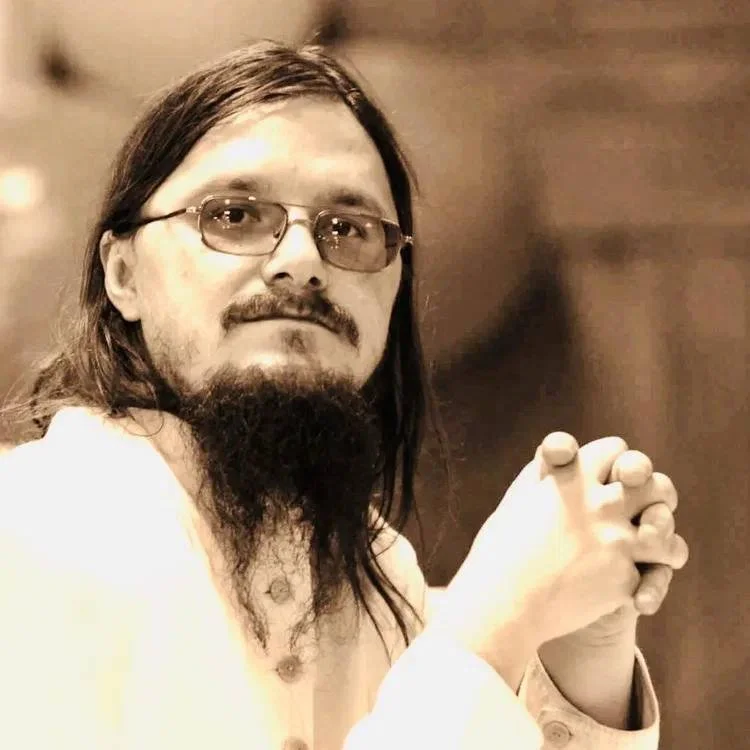
Fr. Daniil Alekseevich Sysoev (Image credit: Wikivorker, Wikimedia Commons)
Fr. Daniil Sysoev was a Russian Orthodox priest and missionary, who tended to deem anything outside of his Orthodox fundamentalist worldview to be demonic, from Karate to Latin dance. However, his primary target was Islam and Muslims. Sysoev devoted much of his energy as a priest trying to convert Muslims by relentlessly attacking them and their faith. While his statements about Islam and Muslims were largely bigoted, self-defeating, or just simply wrong, his status in the Eastern Orthodox Church as a potential martyr and saint has given his Islamophobic rhetoric a mark of virtual infallibility among some Orthodox Christians.
Since Sysoev’s goal as a missionary was to baptize as many Muslims as possible into the Orthodox Church, he demonstrated no interest in genuinely understanding Islam or improving relations between Muslims and Orthodox Christians. On the contrary, he seems to have desired to incite greater tension and distrust between the two groups by misrepresenting Muslims and their religion to a primarily Orthodox audience. While Sysoev made statements about the need for Orthodox Christians to avoid mistreating Muslims, his teachings frequently othered them in some of the worst ways imaginable.
In Islam: An Orthodox Perspective, Sysoev claims that the Islamic world “came into being through the efforts of the spirit of evil,” and that Islam is a scourge of God meant to violently punish lazy Christians. Sounding rather like a spokesperson for al-Qaida or ISIS, he says that Islamist terrorism in Russia is “a visitation from God for the people’s sins.” Thus, rather than presenting Muslims as human beings with intrinsic value and free will, Sysoev portrays them as a sort of biblical plague sent to terrorize Christians into going to church.
Further, since the Prophet Muhammad and the Arabs are traditionally said to have descended from Abraham’s son Ishmael, Sysoev cherry-picks passages from the Bible in order to paint Muslims as ontologically evil. For instance, he quotes Genesis 16:12:
[Ishmael] shall be a wild man;
His hand shall be against every man,
And every man’s hand against him.
And he shall dwell in the presence of all his brethren.
While there are other passages from Genesis that present Ishmael and his descendants in a sacred light, e.g., 17:20, 21:17-8, Sysoev seems to be seeking biblical justification for the Islamophobic trope about Muslims being an existential threat to Christians and the West. It also worth noting that a similar framing of Muslims as the cursed Ishmaelites was used by Serbian Orthodox nationalists to dehumanize Slavic Muslims (Bosniaks) during the Bosnian Genocide and by Israeli Zionists to justify the ongoing genocide of Palestinians.
Because Sysoev believes Islam to be evil, he also portrays Muslims as having a special relationship with demonic forces. For example, he claims that there had been “wide speculation” among Islamic newspapers in Tatarstan about whether or not the Shariʿa permitted intermarriage between Muslims and jinn. Now, even if Sysoev’s claim were true, the reality is that any speculation about the marital eligibility of supernatural beings in some random Islamic publications does not represent mainstream Islam any more than Orthodox writings about flying saucers being piloted by demons represents mainstream Eastern Orthodoxy. Sadly, it seems that Sysoev only mentions such a thing in order to portray Muslims as so inhuman and spiritually deceived that they would even consider marrying what he believed to be demons.
In another attempt to stoke the flames of Islamophobia among Orthodox Christians, Sysoev says that many Muslims believe jihad to be the unofficial sixth pillar of Islam. He also states that “war against the infidels is a must, a doctrinal requirement for a Muslim,” and that “imposing faith by the sword is typical of Islam.” Moreover, Islam is to be seen as a Trojan horse within any multicultural society, since Muslims will supposedly attempt to force their religion on the rest of the population as soon as they become strong enough. One of the many ironies of such claims is the fact that Sysoev’s own missionary work among Central Asian and Caucasian Muslims was in no small part facilitated by Russia’s long history of brutal conquest and subjugation of Muslim lands. Furthermore, Sysoev claims in a letter that God arranges wars to destroy Muslim-majority nations in order to bring Christianity to their people, and even uses Iraq as an example. Thus, it seems that employing violence to spread one’s faith is only a problem if Muslims do it.
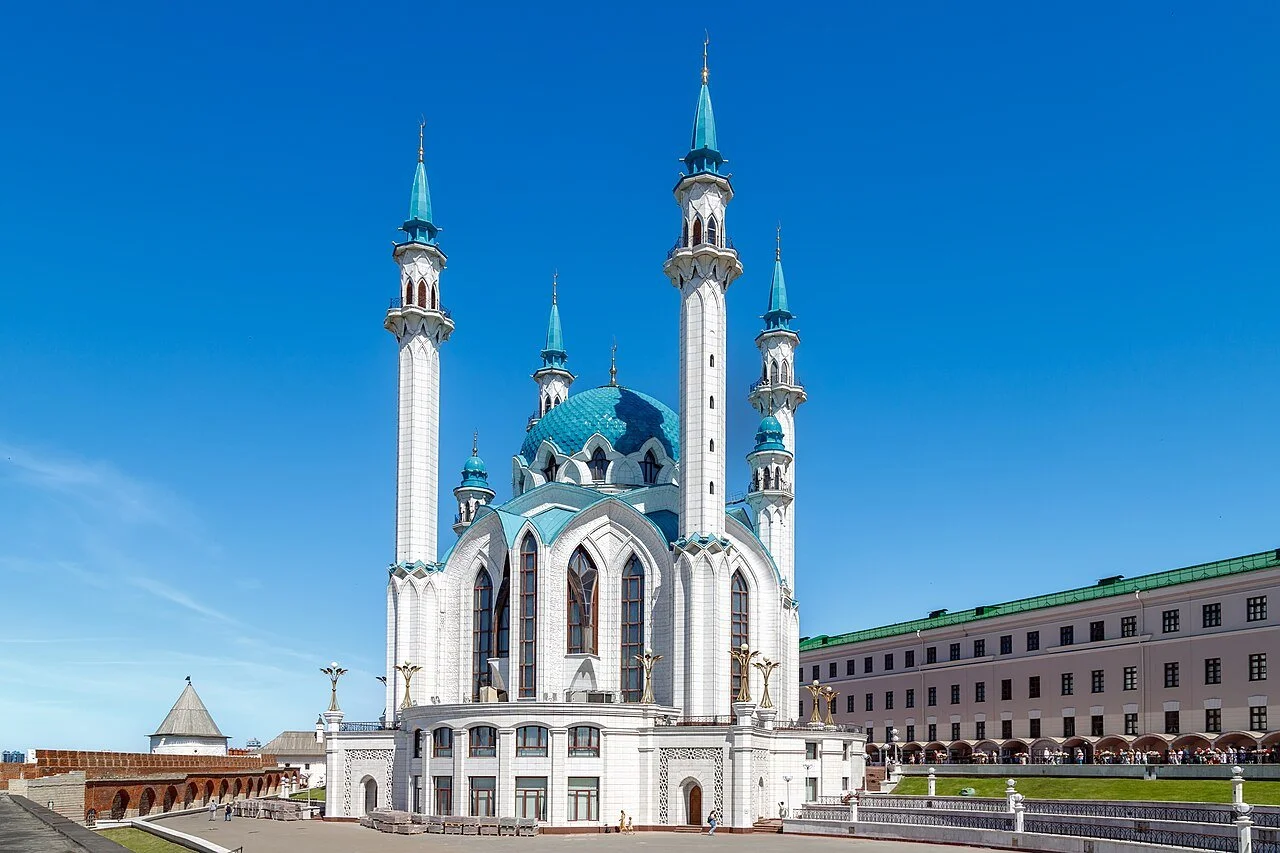
Kul Sharif Mosque (Qol Şärif Mäçete), Kazan, Tatarstan. Rebuilt in 2005, the original mosque was destroyed by the forces of Tsar Ivan the Terrible during the Siege of Kazan (1552). (Image credit: Mike1979 Russia, Wikimedia Commons)
Sysoev also claims that Wahhabism—i.e., the eighteenth-century Salafi movement most associated with extremism and terrorism—is the purest form of Islam in existence, and that prior to Muhammad ibn ʿAbd al-Wahhab’s reforms, “Islam in Arabia had completely dissolved into paganism, and little was left of Islam but its formal shell.” Such “paganism” included “reverence for saints, cults of sacred places, and Sufism.” Sysoev essentially presents the Wahhabi claim to be the most genuine imitators of the salafi, that is, the Prophet and the first three generations of Muslims, as a given. While he may actually believe this to be the case, it seems rather convenient for his Islamophobic outlook that the most controversial and extreme interpretation of the Islamic tradition just also happens to be the least adulterated. Of course, Sysoev does not apply the same reasoning to Christianity. For instance, he never concludes that Eastern Orthodox practices such as prayers to saints, veneration of their relics and tombs, or Hesychasm are “pagan” because they developed after the apostolic period. In truth, if one were to evaluate Christian orthodoxy by the same criterion that Sysoev evaluates Islamic orthodoxy, they may have to conclude that Puritanism was actually the most authentic Christian movement since the time of the nascent church.
Sysoev also denies that Muslims and Orthodox Christians worship the same God and looks for various ways to justify this position. For example, he attacks the Qurʾanic portrayal of hell in order to prove that the God of the Muslims is little more than a sadist modeled after human nature. Sysoev says that according to the Muslim scripture, “Whoever hates [Allah] will enjoy sheer torture: they will burn in hell, and He will give them a new skin each time, to prolong their suffering. This will last forever, and they will be given molten iron to drink.” Frankly, it is difficult to see how he can genuinely think that any of these teachings create a rift between Islam and Christianity. For passages about the damned being tormented by fire and other forms of punishment are also found in the Bible, e.g., Matt. 13:41-2, Rev. 14:9-11. Moreover, Sysoev himself holds extreme views about the afterlife. For example, he teaches that all of the unbaptized, including infants, will spend eternity in hell. He also writes to a Muslim who contested the Bible’s inerrancy that “the punishment for Muslims will be the flames of Gehenna.”
In a further bid to make it seem as if Muslims worship a nefarious deity, Sysoev claims the Islam holds God to be the source of sin and evil:
Another obligatory article of Muslim doctrine is belief in predestination. According to hadith and the Quran, 50 thousand years before creation Allah told a pen to begin writing, and the pen began writing down everything to come until the end of time. […] According to this teaching Allah is the creator of all deeds, both evil and good. […] Allah enables the murderer to kill, the adulterer to commit adultery, and the clement man to give alms.
Although Sysoev may come across as wholly rejecting predestination, when explaining salvation from the Orthodox perspective in a letter, he states, “The fact is that God saves only those predestined for salvation.” So what he seems to be criticizing is a form of fatalism that holds human beings to be God’s puppets. For he also says, “[Allah] makes one stray from or keep to the path as he wills. Thus, both good and evil are of him.” Of course, there are multiple passages in the Qurʾan that speak of God leading people one way or another, e.g., “Whomsoever God will, He leads astray, and whomsoever He will, He places him upon a straight path” (6:39), or
Truly it is the same for the disbelievers whether thou warnest them or warnest them not; they do not believe. God has sealed their hearts and their hearing. Upon their eyes is a covering, and theirs is a great punishment (2:6-7).
But does the Bible not make similar statements? For example, although God instructs Moses to demand of Pharaoh that he free the Israelites, he also says,
I will harden Pharaoh’s heart, and multiply My signs and My wonders in the land of Egypt. But Pharaoh will not heed you, so that I may lay My hand on Egypt and bring My armies and My people, the children of Israel, out of the land of Egypt by great judgments (Exod. 7:3-4).
Regarding the hardening of Pharaoh’s heart, St. Paul writes,
[God] has mercy on whom He wills, and whom He wills He hardens. You will say to me then, ‘Why does He still find fault? For who has resisted His will?’ But indeed, O man, who are you to reply against God? (Rom. 9:18-20).
Further, it is written in Isaiah, “I make peace, and create evil: I the Lord do all these things” (45:7). If one were to read such biblical passages in the same manner that Sysoev read similar verses from the Qurʾan, they may have to conclude that the Bible also portrays God as the source of sin and evil. However, both Muslims and Christians believe God to be good, and that passages that may seem to suggest otherwise need to be read in the larger context of scripture and tradition.
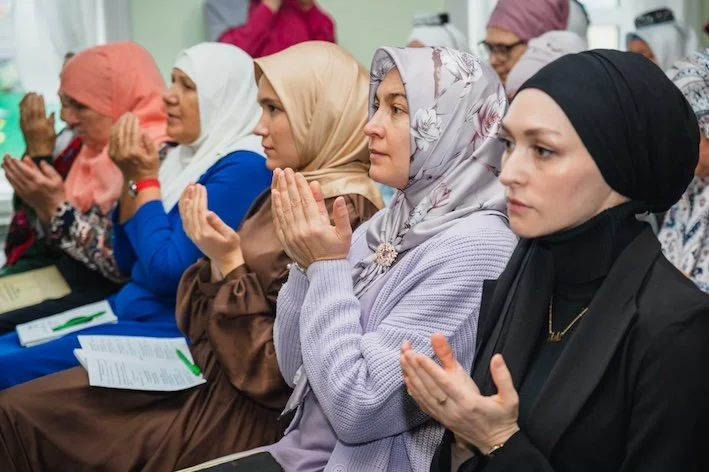
Muslim women praying in First Cathedral Mosque, Chistopol, Tatarstan (Image credit: Wikimedia Commons)
Partially owing to his muddled understanding of Islam and predestination, Sysoev also alleges that Muslims do not truly pray:
The rite of adoration (namaz) is not prayer. The texts read during namaz merely describe man’s attitude toward God, with no supplication whatsoever. There is a separate form of prayer in which a person may pray to Allah regarding his problems, but this is not highly approved of due to the doctrine of predestination: if everything is predestined, what is there to pray for?
Of course, Namaz, or Salah, is not only prayer but also includes supplications, e.g., “God give us goods in this world and goods in the hereafter and guard us from the torment of fire”; “You alone do we ask for help. Lead us along the straight path.” Moreover, the practice of informal supplicatory prayer, or duʿaʾ, is common among all Muslims. In fact, the Qurʾan encourages believers to call upon God for help, e.g., 2:186, 40:60.
Despite Fr. Daniil Sysoev’s fixation on disproving Islam, it is abundantly clear that his understanding of it was quite limited. Moreover, his dissemination of Islamophobic propaganda indicates that he also sought to dehumanize Muslims in the eyes of Orthodox Christians. However, if anything positive can be gleaned from Sysoev’s anti-Muslim polemics, it is that they tend to illustrate the very opposite of what he sets out to prove. That is to say, rather than showing that Islam and Eastern Orthodoxy are two diametrically opposed religious traditions, his rhetoric demonstrates the invariable difficulty of denigrating the beliefs and practices of Muslims without simultaneously disparaging those of Orthodox Christians, e.g., when he calls Muslim reverence for saints “pagan,” or when he attacks Qurʾanic teachings about hell. Of course, this only further testifies to just how near the two Abrahamic traditions truly are to one another. While I have little doubt that Sysoev will eventually be proclaimed a saint by the Moscow Patriarchate, nothing can ever sanctify his many false and harmful statements about Islam and Muslims.