Kindred Paths to Union with God: Parallels Between Sufism and Hesychasm
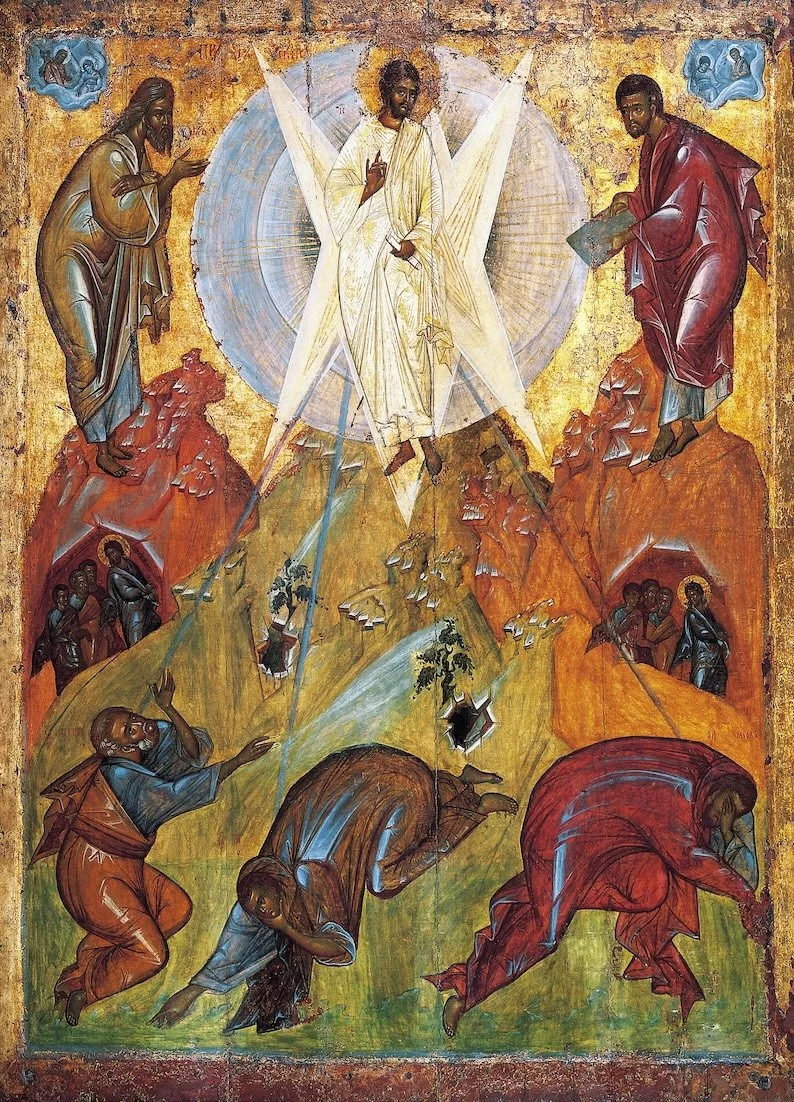
15th-century Russian Orthodox icon of the Transfiguration, attributed to Theophanes the Greek (Image credit: Wikimedia Commons)
The ultimate goal of both Sufism and Hesychasm is to achieve union with the God of Abraham. Despite little religious borrowing having occurred historically between the two traditions, Sufis and Hesychasts employ strikingly similar methods to realize divine union. Moreover, they also possess a rather akin understanding of what it means for a person to be united with the one God. As Sufism and Hesychasm are contemplative, mystical paths known in their essence only by those who have walked them, I will rely primarily on the sacred examples and teachings of Sufi and Hesychast masters in order to present some of their most significant outward and inner parallels.
Firstly, it should be stated that orthodox Sufis and Hesychasts do not see themselves as being somehow above the fundamental requirements of their respective religion. As Sufism is simply the inner mystical dimension of Islam, its genuine practitioners follow the Qurʾan and the example of the Prophet Muhammad, observe the five pillars of Islam, and abide by the Shariʿa. While as Eastern Orthodox Christians, Hesychasts accept the doctrines of the Church, partake in its holy mysteries, observe its various fasts etc. Further, neither Sufi nor Hesychast is to attempt to realize divine union without a repentant heart and the help of a trusted spiritual guide. Since Hesychasts are usually monastics, this often means finding a holy abbess or abbot to lead them on their spiritual journey. Whereas the Sufi is to go under the direction of an authentic shaykha or shaykh. Rumi states, “Nothing kills the ego but the shadow of the shaykh: cling tightly to the skirt of that ego-killer!” Sufis and Hesychasts must humble themselves within the parameters of Islam or Eastern Orthodoxy if they are to one day ascend to divine heights.
Of course, the central method of divine ascent is that of sincere and frequent prayer. While humankind has come to know God in a more general manner through the many prophets he has sent into the world, Sufis practice an invocatory prayer known as dhikr, or remembrance of God, as a means to know him in a far more intimate way. In fact, ʿAli ibn Abi Talib states, “Perpetuate the dhikr, for truly it illuminates the heart, and it is the most excellent form of worship.” When practicing dhikr, Sufis use a set of prayer beads called a misbaha (or tasbih) to assist in the repetition of either one of the ninety-nine names God, the first half of the shahada, or the term Allah. They also often use breathing techniques in order to connect the prayer to their inhales and exhales, creating a physical and spiritual rhythm to their practice. Moreover, each of God’s ninety-nine names represents a different divine attribute, e.g., al-Haqq (the Truth) or al-Rahman (the Merciful). A shaykha/shaykh may even recommend that a disciple invoke a specific divine name based on their current spiritual level. For instance, in his introduction to Sufism, Carl W. Ernst notes that Ibn ʿAtaʾ Allah al-Iskandari said that reciting the name al-Matin (the Strong) was “harmful to the masters of seclusion” but beneficial to those lacking in reverence.
Hesychasts, on the other hand, devote themselves to saying the Jesus Prayer. The term Hesychasm comes from the Greek word esychia, meaning silence or stillness. For the Hesychast is the one who becomes truly silent in order to hear God. Using a komboskoini (prayer rope), they repeat the invocatory prayer, “Lord Jesus Christ, Son of God, have mercy on me.” While there are slight variations of the prayer, it is always centred upon the sacred name of the Word of God, with some more advanced ascetics repeating only the name Jesus. Moreover, Hesychasts also use breathing exercises to help them focus during prayer. In his detailed instructions for those who unfortunately lack an authentic guide but still wish to say the Jesus Prayer at a higher level, St. Nicephorus the Hesychast writes, “Seat yourself, then, concentrate your intellect, and lead it into the respiratory passage through which your breath passes into your heart. Put pressure on your intellect and compel it to descend with your inhaled breath into your heart.” Furthermore, St. Gregory Palamas teaches that breathing exercises are particularly valuable for beginners prone to distraction. However, because true prayer can only be achieved by God’s grace, and not simply an individual’s own asceticism or skill, physical techniques are usually discarded as one advances spiritually.
Despite the vital role usually played by religious icons in Orthodox worship, Hesychasts are to remove all external and internal images when reciting the Jesus Prayer. In fact, St. Nil of Sora teaches that one should eliminate all thoughts from their mind when saying the prayer, including those which may appear pious or beneficial. While St. Gregory of Sinai warns against imagining so much as a colour one might associate with the divine. For anything created, including one’s thoughts, will inevitably fall short of the uncreated God, who, in the words of Pseudo-Dionysius, “is at a total remove from every condition, movement, life, imagination, conjecture, name, discourse, thought, conception, being, rest, dwelling, unity, limit, infinity, the totality of existence.” Hesychasts must completely empty their minds during contemplation in order to see God as he is.
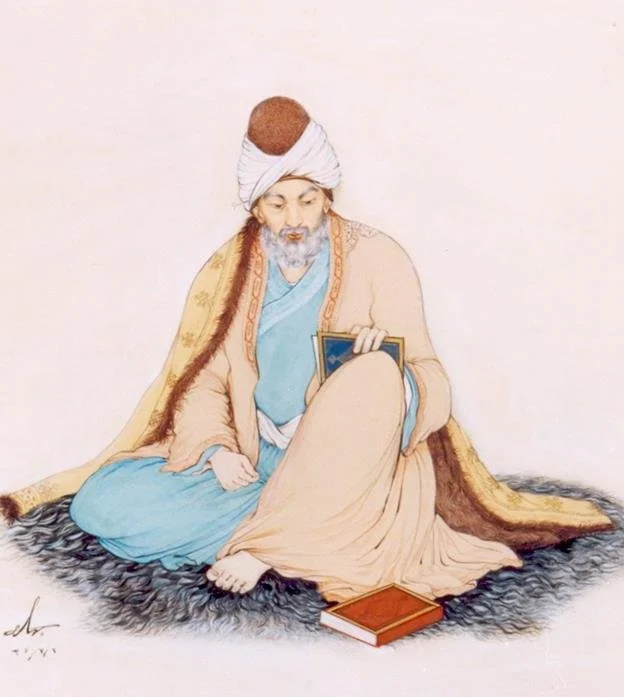
Mawlana Jalal al-Din Rumi by Husayn Bihzad (Image credit: Wikimedia Commons)
As Muslims, Sufis reject artistic representations of God and rarely include images of the prophets or saints in their worship. According to Ibn ʿArabi, it is through the practice of dhikr that a person overcomes the world of imagination and learns the abstract meanings hidden behind matter. Moreover, Rumi says that the things we imagine are only derivatives of the divine. Yet, the imagination has a nearly immeasurable influence over the vast majority of humankind, since it is usually confused with the reality, God. Rumi writes,
All day long the kicks of imagination, worry
over profit and loss, and fear of extinction leave the spirit
No purity or gentleness or splendor, nor any
way to travel to heaven.
While people often attempt to use their imagination as a means to escape suffering, the truth, at least according to Rumi, is that our thoughts can only torment us. The remedy is to rid the mind of all thoughts and to turn one’s heart towards God, that is, the one who is beyond thought.
Sufis and Hesychasts also strive to achieve what is known as prayer of the heart. In How Do We Enter the Heart?, Metropolitan Kallistos Ware writes, “The heart is the point of meeting between human freedom and Divine grace, between image and Archetype, between the created and the Uncreated.” The human heart is the receptacle of God. Further, Pseudo-Macarius states,
The heart governs and reigns over the whole bodily organism; and when grace possesses the pasturages of the heart, it rules over all the members and the thoughts. For there, in the heart, is the intellect (nous), and all the thoughts of the soul and its expectation; and in this way grace penetrates also to all the members of the body.
Because the heart is the centre of the human being, prayer of the heart is prayer of the entire person.
By practicing the Jesus Prayer, Hesychasts are able to overcome their egotistical passions and receive the gift of unceasing prayer of the heart. While a person who attempts to literally pray unceasingly with their tongue risks falling into prelest (spiritual delusion) or simply going insane, the unceasing prayer of the Hesychast is accomplished not by human effort but by the work of the Holy Spirit. Speaking about his own experience of the gift of unceasing prayer, St. Iosif the Hesychast says,
At once I was completely changed, and forgot myself. I was filled with light in my heart and outside and everywhere, not being aware that I even had a body. The prayer began to say itself within me, so rhythmically that I was amazed, since I myself was not making any effort.
The heart of the spiritually advanced Hesychast begins to unceasingly say the Jesus Prayer without any sort of exertion on the part of the individual. Hence, the prayer continues to repeat in the Hesychast’s heart even if, for example, they are carrying on a conversation with another person or giving a sermon in church. This is why the Orthodox Church portrays Hesychasm as the very fulfilment of St. Paul’s injunction to “pray without ceasing” (1 Thess. 5:17).
In the above quote, Iosif also mentions a light that was both within and without him. The light experienced by genuine Hesychasts is nothing other than the uncreated light of God. It is the same divine light experienced by Moses at the burning bush, the apostles at Jesus’s Transfiguration, and St. Stephen during his stoning. Furthermore, St. Gregory of Nyssa states, “It is not possible to see the light without seeing in the light.” In other words, a person does not come to see God by the strength of their own flesh and blood but by the power and grace of the Holy Spirit. For God is known through God. Palamas, however, draws a distinction between the essence (ousia) and the energies/operations (energeiai) of God. While the divine essence remains unknowable to creation, Hesychasts participate in God’s energies/operations. That being said, some prominent Eastern Orthodox thinkers, such as David Bentley Hart and Robert Fortuin, have argued that a distinction between God’s essence and energies/operations can only be a conceptual one.
By experiencing the divine light and attaining unceasing prayer of the heart, the Hesychast undergoes a transformation called theosis, or deification. Regarding theosis, St. Maximus the Confessor writes, “He [i.e., the deified person] remains entirely man by nature in his soul and body, and becomes entirely God in his soul and body through grace, and through the divine radiance of the blessed glory with which he is made entirely resplendent.” By being united with God, the deified become gods by grace. While this may sound scandalous to some, it should be noted that when criticized for calling himself the Son of God, Jesus reminded his detractors that even the Old Testament referred to some people as “gods” (John 10:34-6).
Because the deified participate in the divine energies, they gain potentially limitless insights into God and the universe. Maximus says, “He who has been found worthy to enter into God will perceive preexisting in God all those inner principles of created things, through a simple and indivisible knowledge.” While St. Gregory Nazianzen postulates that those who have been united with God perhaps know him as well as he knows them. Since, as Palamas puts it, “they know God in God.” It may then be said that Evagrius Ponticus’s famous maxim—“If you are a theologian, you will pray truly; and if you pray truly, you will be a theologian”—is fully realized in the Hesychast.
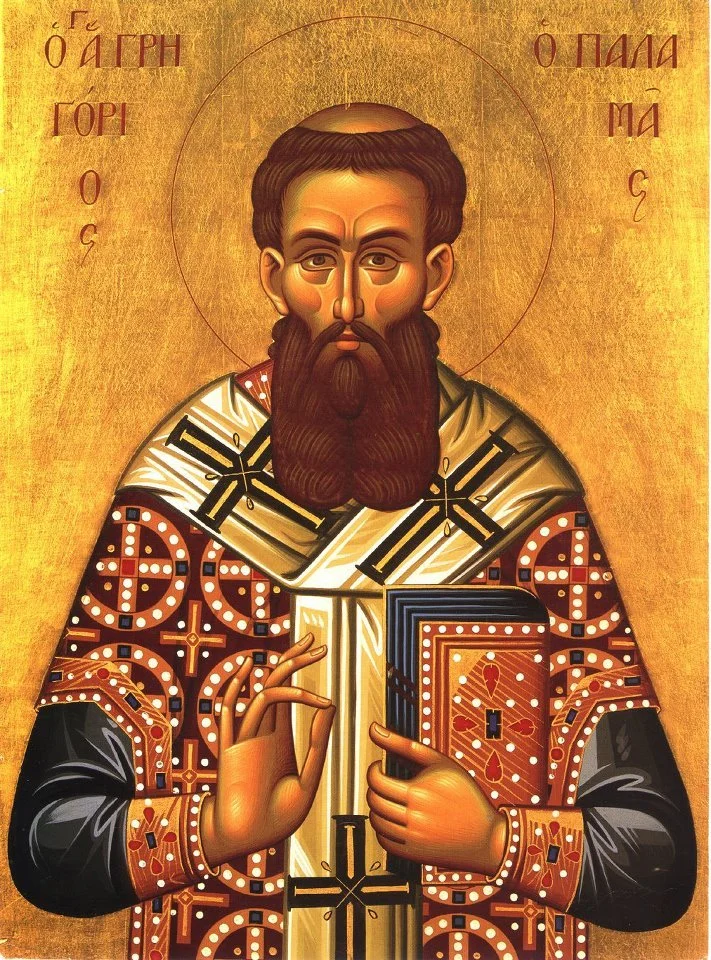
Greek Orthodox icon of St. Gregory Palamas, archbishop of Thessaloniki (Image credit: Orthodox Church in America)
Sufis also seek the uncreated light of God. Rumi says, “Know that everything other than the eternal light has newly come into existence.” Moreover, it is the heart that receives the divine light. In a hadith qudsi, God states, “My earth and My heaven embrace Me not, but the heart of My believing servant does embrace Me.” The heart, which Shams al-Din Lahiji calls the “depository of the Divine mysteries,” embraces God by becoming a mirror capable of reflecting his light. But one’s heart needs to be fully cleansed in order to fulfill its true calling. Muhammad says, “The polish of the heart is dhikr, the invocation of God.” As the Sufi advances in dhikr, the ego, that is, the I-ness that maintains a wall of separation between the believer and God, is annihilated. It is at this point that the Sufi’s heart becomes aflame with the divine light, and they are united with God. To illustrate divine union, Rumi gives the example of two lovers:
One morning a beloved said to her lover to test
him, “Oh so-and-so,
I wonder, do you love me more, or yourself?
Tell the truth, oh man of sorrows!”
He replied, “I have been so annihilated within
thee that I am full of thee from head to foot.
Nothing is left of my own existence but the
name. In my existence, oh sweet one, there is naught but thee.
I have been annihilated like vinegar in an ocean
of honey.”
The annihilated Sufi loses themselves in the divine. Therefore, when the martyr Mansur al-Hallaj was asked to recant having ecstatically proclaimed, “Ana al-Haqq,” or “I am the Truth,” he said he could not. For his “I” no longer referred to his own finite personhood but to the one eternal creator. Farid al-Din ʿAttar compares al-Hallaj’s proclamation to the theophany of the burning bush, since it was God who spoke in both cases.
Some Sufis describe their annihilation along the lines of the Prophet’s ascension, or miʿraj. For instance, Bayazid Bastami spoke openly of having ascended spiritually, though not physically, through the seven heavens to the throne of God. He tells us that the creator felt closer to him than his own spirit. Subsisting in God, Bayazid, for whom the notion of his own personal existence would have meant the denial of God’s unity, or tawhid, would cry out in ecstasy, “Glory be to Me! How great is My Majesty!”
In The Heart of the Faithful is the Throne of the All-Merciful, Seyyed Hossein Nasr writes,
What is permanent is our nothingness (al-fanāʾ) before God; one is to become a perfect mirror which, in being nothing in itself, is able to reflect forms emanating from above. The peace of the heart is precisely our total surrender to God, not only on the level of the will, but also on the level of existence. To become “nothing” before God is to be at once “nothing” and “everything.”
The saint becomes “nothing” by ceasing to exist as an individual and “everything” by being in union with the one God.
Annihilation also exposes the Sufi to knowledge that would have otherwise been inaccessible to a human being. Rumi states, “Knowing the science of ‘I am God’ is the science of bodies, but becoming ‘I am God’ is the science of religions.” While the former denotes exterior knowledge acquired through human effort, such as by studying a particular subject, the term “science of religions” refers to esoteric knowledge attained through divine experience, i.e., annihilation and union. For seeing by the light of God, the annihilated Sufi is able to gain an interior understanding of reality. Rumi says that those who have been united with God can even come to know his very essence. In fact, Sufis view Muhammad as the example par excellence of the contrast between the two types of knowledge, since he knew the mysteries of the universe while being illiterate.
Even without being able to see by the divine light, it is clear that there are many striking outward and inner parallels between Sufism and Hesychasm. Moreover, these parallels, from the frequent invocation of one of God’s names to the attainment of divine union, are not mere coincidences but evidence of kindred mystical experiences with the God of Abraham. It may be said that despite some of the theological and practical differences that exist between Islam and Eastern Orthodoxy, their inner dimensions, i.e., Sufism and Hesychasm, reveal that on the highest spiritual plane, that is, where the believer is united with God, the two holy paths converge. This is not, however, to advocate for syncretism. For the Sufi achieves annihilation as a true Muslim, while the Hesychast reaches theosis as a true Christian. Yet, it seems that the destination that each one arrives at is one and the same. This should also perhaps encourage Muslims and Orthodox Christians to engage in a more robust study of one another’s mystical traditions. For a Muslim may gain new insights into Sufism by reading Maximus or Palamas, just as an Orthodox Christian can deepen their understanding of Hesychasm by studying Rumi or Ibn ʿArabi. For such saints have been set aflame by the divine light. Thus, Muslims and Orthodox Christians would be wise to help illuminate their respective paths to God with as many of his holy torches as possible.